Wildfire Burn Zones
get_wildfire_burn_zones.RmdOverview
The get_wildfire_burn_zones() function provides access
to a harmonized dataset of wildfire burn zone disasters in the United
States from 2000-2025.
Data sources and methodology
This dataset combines six authoritative wildfire data sources to identify wildfires that burned near communities and resulted in civilian fatalities, destroyed structures, or received federal disaster relief. These sources are:
- FIRED (Fire Event Delineation): Satellite-derived fire perimeters
- MTBS (Monitoring Trends in Burn Severity): Burn severity and perimeters for large fires
- NIFC (National Interagency Fire Center): Official fire incident data
- ICS-209 (Incident Status Summary): Incident management records
- RedBook: Historical wildfire statistics
- FEMA: Federal disaster declarations
Wildfires are classified as “disasters” if they:
- Burned near a community AND
- Resulted in at least one of:
- Civilian fatality
- Destroyed structure
- Federal disaster relief
These data are described and provided in association with the journal article: Wilner, L.B., Piepmeier, L., Gordon, M. et al. Two and a half decades of United States wildfire burn zone disaster data, 2000-2025. Sci Data 12, 1948 (2025). https://doi.org/10.1038/s41597-025-06226-8.
Loading the data
library(climateapi)
library(tidyverse)
library(sf)
library(urbnthemes)

set_urbn_defaults(style = "print")
burn_zones <- get_wildfire_burn_zones()Data structure
Each row in the dataset represents a single wildfire burn zone disaster.
glimpse(burn_zones)
#> Rows: 8,010
#> Columns: 19
#> $ wildfire_id                          <dbl> 1, 1, 2, 3, 4, 5, 6, 7, 8, 9, 10…
#> $ id_fema                              <chr> NA, NA, "FM-5491-OK", NA, NA, "F…
#> $ year                                 <int> 2018, 2018, 2024, 2017, 2014, 20…
#> $ wildfire_name                        <chr> "DONNELL", "DONNELL", "57", "GAR…
#> $ state_fips                           <chr> "06", "06", "40", "12", "02", "1…
#> $ county_fips                          <chr> "06003", "06109", "40153", "1208…
#> $ county_name                          <chr> "Alpine County", "Tuolumne Count…
#> $ area_sq_km                           <dbl> 146.200893, 146.200893, 19.10569…
#> $ wildfire_complex_binary              <lgl> FALSE, FALSE, FALSE, FALSE, FALS…
#> $ date_start                           <date> 2018-08-01, 2018-08-01, 2024-04…
#> $ date_containment                     <date> 2018-10-31, 2018-10-31, 2024-04…
#> $ fatalities_total                     <int> NA, NA, NA, NA, NA, NA, NA, NA, …
#> $ injuries_total                       <int> 6, 6, 2, NA, NA, 1, NA, NA, NA, …
#> $ structures_destroyed                 <int> 135, 135, 1, 19, 5, 4, 4, 7, 3, …
#> $ structures_threatened                <int> NA, NA, 1720, NA, 0, 0, NA, NA, …
#> $ evacuation_total                     <int> NA, NA, NA, NA, NA, 7000, 50, NA…
#> $ wui_type                             <chr> NA, NA, NA, "intermix", NA, "int…
#> $ density_people_sq_km_wildfire_buffer <dbl> 0.07433545, 0.07433545, 4.128572…
#> $ geometry                             <POLYGON [m]> POLYGON ((-2033577 19616…
Key variables include:
-
wildfire_id: Unique identifier for each wildfire event -
year: Year the wildfire occurred (2000-2025) -
wildfire_name: Name of the wildfire or fire complex -
county_fips: Pipe-delimited string of county FIPS codes for all affected counties -
county_name: Pipe-delimited string of county names for all affected counties -
area_sq_km: Burned area in square kilometers -
fatalities_totalandinjuries_total: Human impacts -
structures_destroyedandstructures_threatened: Built environment impacts -
geometry: Burn zone polygon boundaries
Example analyses
Annual trends in wildfire disasters
# Extract state FIPS from the first county in the pipe-delimited list
df1 = burn_zones |>
  st_drop_geometry() |>
  mutate(state_fips = str_sub(county_fips, 1, 2)) |>
  summarize(
    .by = c(year, state_fips),
    n_wildfires = n(),
    total_area_sq_km = sum(area_sq_km, na.rm = TRUE),
    total_structures_destroyed = sum(structures_destroyed, na.rm = TRUE)) |>
  left_join(
    tigris::fips_codes %>% distinct(state, state_code),
    by = c("state_fips" = "state_code"))

top_five_states = df1 %>%
  arrange(desc(n_wildfires)) %>%
  distinct(state) %>%
  slice(1:5)

df1 %>%
  filter(state %in% top_five_states$state) %>%
  mutate(state = factor(state, levels = top_five_states %>% pull(state), ordered = TRUE)) %>%
  ggplot(aes(x = year, y = n_wildfires)) +
  geom_col() +
  labs(
    title = "Many states frequently experience more than 50 wildfires per year",
    subtitle = "Disasters defined as wildfires causing fatalities, structure loss, or federal relief",
    x = "",
    y = "Number of wildfires") +
  facet_wrap(~state)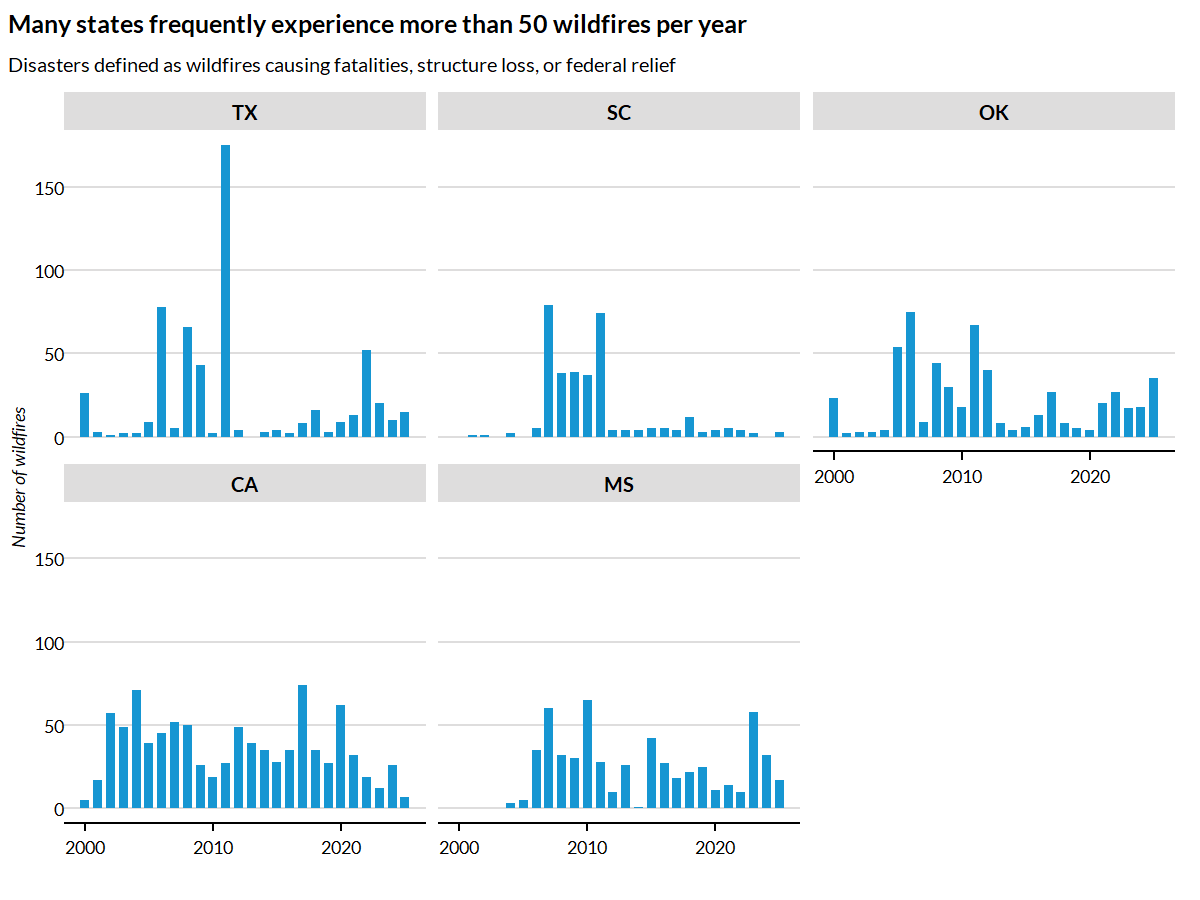
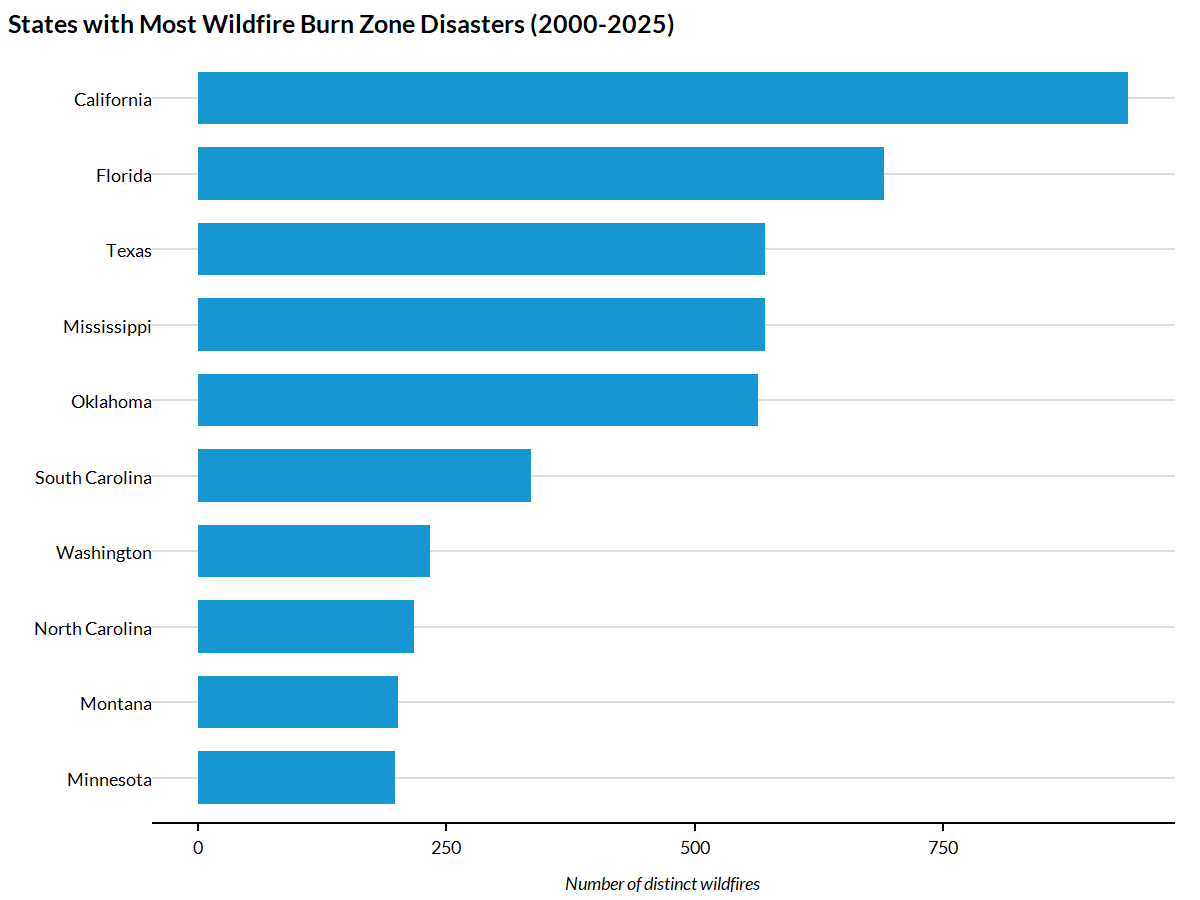
Geographic distribution of impacts
state_impacts <- burn_zones |>
  st_drop_geometry() |>
  mutate(state_fips = str_sub(county_fips, 1, 2)) |>
  summarize(
    .by = state_fips,
    n_wildfires = n_distinct(wildfire_id),
    total_structures_destroyed = sum(structures_destroyed, na.rm = TRUE),
    total_fatalities = sum(fatalities_total, na.rm = TRUE)
  ) |>
  left_join(
    tidycensus::fips_codes |>
      distinct(state_code, state_name),
    by = c("state_fips" = "state_code")
  ) |>
  filter(!is.na(state_name))

state_impacts |>
  slice_max(n_wildfires, n = 10) |>
  mutate(state_name = fct_reorder(state_name, n_wildfires)) |>
  ggplot(aes(y = state_name, x = n_wildfires)) +
  geom_col() +
  labs(
    title = "States with Most Wildfire Burn Zone Disasters (2000-2025)",
    x = "Number of distinct wildfires",
    y = ""
  )
Mapping wildfire burn zones
# Get wildfires from a recent year in California
ca_2020_fires <- burn_zones |>
  filter(str_detect(county_fips, "^06"), year == 2020)

# Get California counties for context
ca_counties <- tigris::counties(state = "CA", cb = TRUE, year = 2022, progress_bar = FALSE) |>
  st_transform(5070)

ggplot() +
  geom_sf(data = ca_counties, fill = "grey95", color = "grey70") +
  geom_sf(data = ca_2020_fires, aes(fill = structures_destroyed), alpha = 0.8) +
  scale_fill_continuous(trans = "reverse") +
  labs(
    title = "California Wildfire Burn Zone Disasters (2020)",
    subtitle = "Burn zone perimeters colored by structures destroyed",
    fill = "Structures\ndestroyed") +
  theme_urbn_map()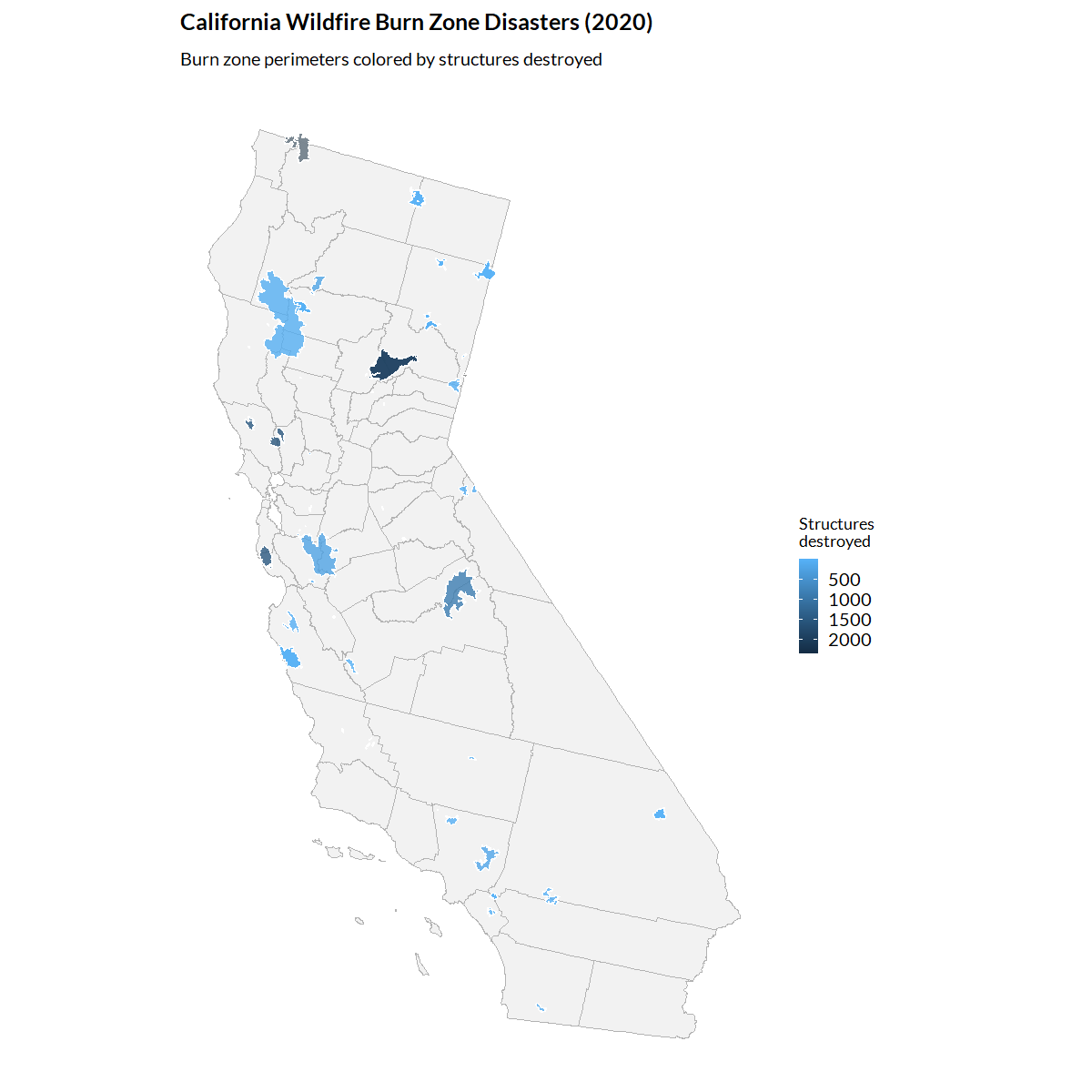
Analyzing structure loss severity
burn_zones |>
  st_drop_geometry() |>
  distinct(wildfire_id, year, wildfire_name, structures_destroyed) |>
  filter(!is.na(structures_destroyed), structures_destroyed > 0) |>
  mutate(
    severity = case_when(
      structures_destroyed >= 1000 ~ "1,000+ structures",
      structures_destroyed >= 100 ~ "100-999",
      structures_destroyed >= 10 ~ "10-99",
      TRUE ~ "1-9 structures"),
    severity = factor(
      severity,
      levels = c("1-9 structures", "10-99", "100-999", "1,000+ structures"))) |>
  count(year, severity) |>
  mutate(
    .by = year,
    percent = n / sum(n, na.rm = TRUE)) |>
  ggplot(aes(x = year, y = percent, fill = severity)) +
  geom_col() +
  scale_fill_manual(values = c(
    "1-9 structures" = palette_urbn_cyan[1],
    "10-99" = palette_urbn_cyan[3],
    "100-999" = palette_urbn_cyan[5],
    "1,000+ structures" = palette_urbn_cyan[7])) +
  scale_y_continuous(labels = scales::percent) +
  labs(
    title = "Most wildifres destroy under 10 structures",
    x = "",
    y = "")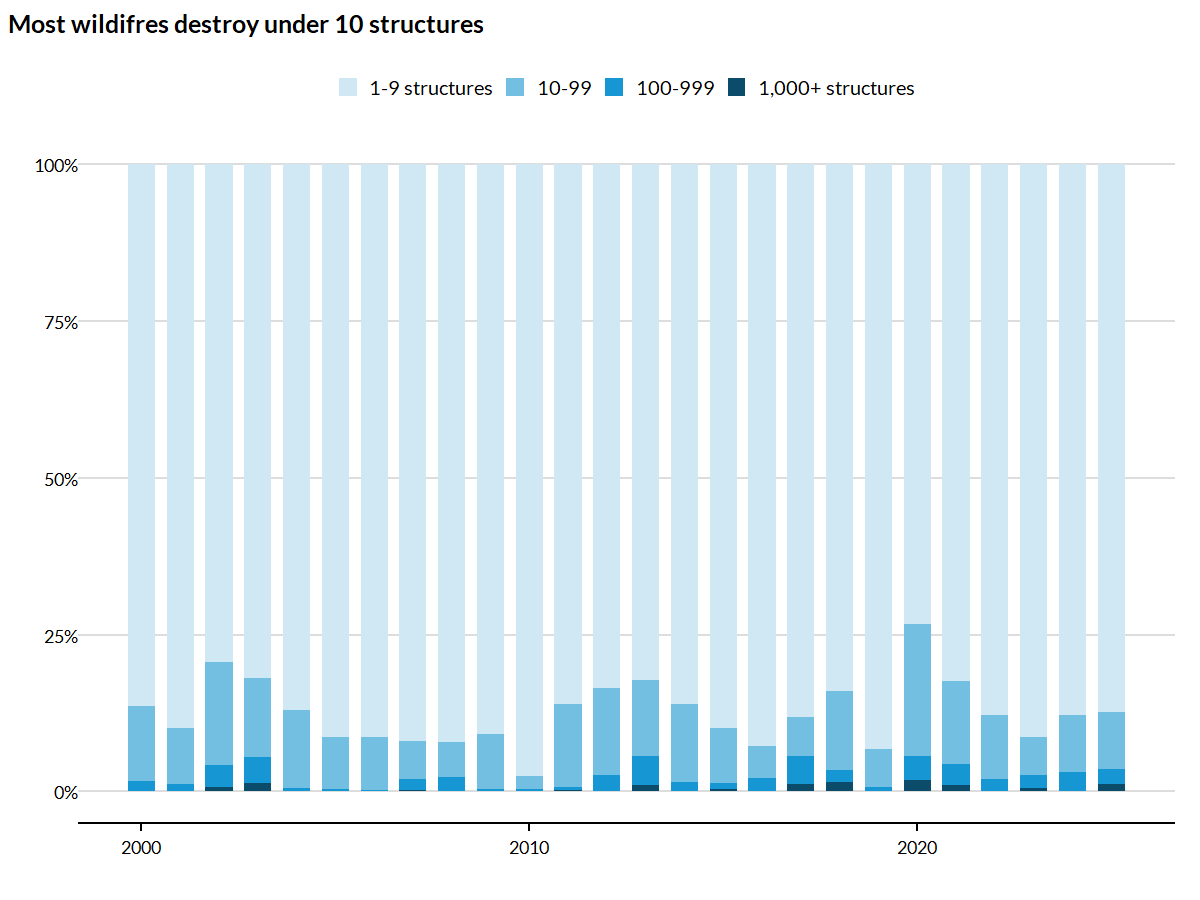
See also
-
get_current_fire_perimeters(): Access current/active wildfire perimeters -
get_fema_disaster_declarations(): FEMA disaster declarations including fire-related declarations -
get_structures(): Estimate structures within geographic boundaries